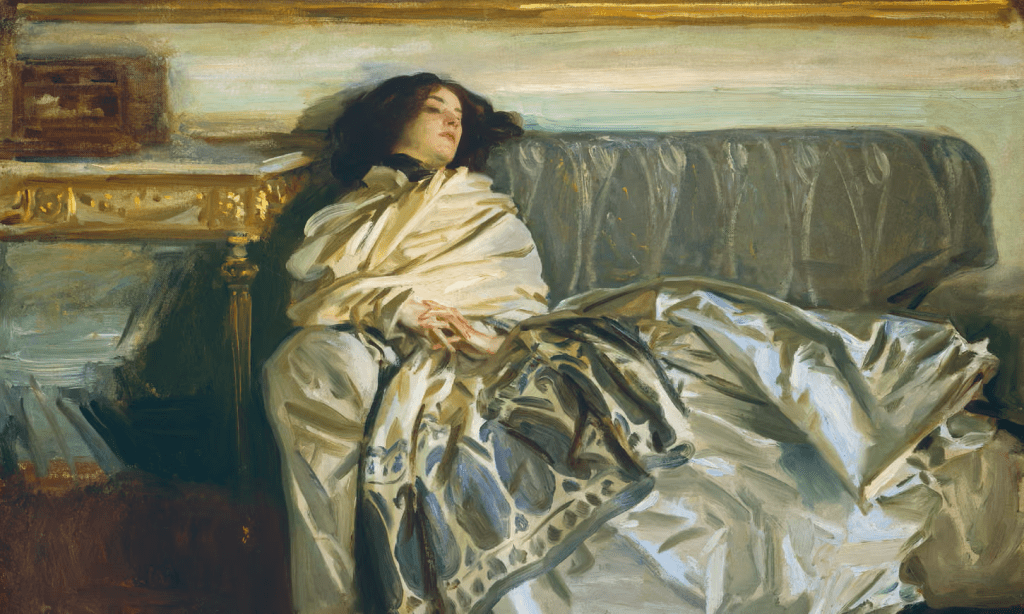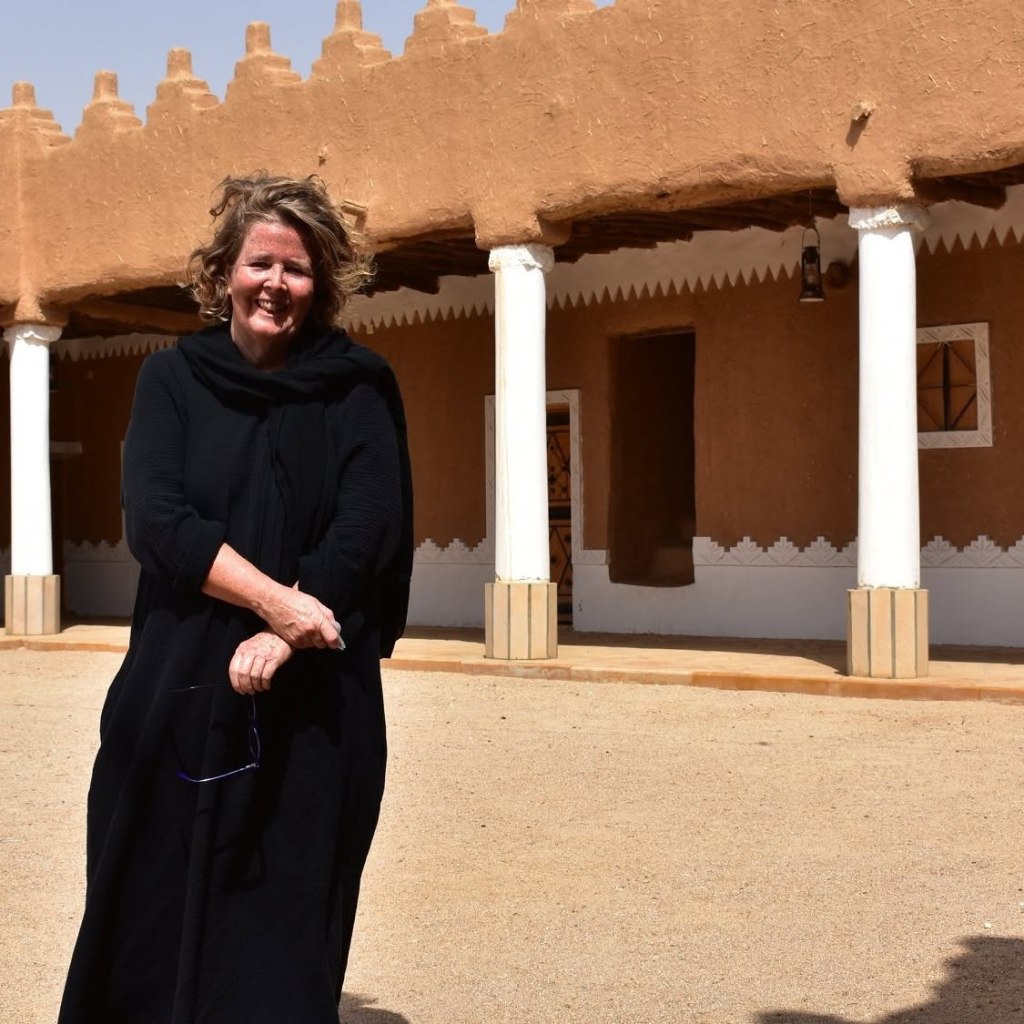
I called her The Inspector because that’s what she felt like the first time I met her. She was English, tall and slim, and a Moslem revert – as many term it – with a spirited intelligent face and a great sense of fun, which you could see from the lines at the sides of her eyes and because she was always smiling, even when you weren’t looking at her.
Of course she wasn’t really an inspector, but her height, breezy mien and vigorus gait gave her the air of someone supervising others in an efficient but friendly way.
Also, although she was a fellow English instructor, most of the time she was in the corridors and not in her classroom, where sulking and insolent students lolled around at their expensive desks, exchanging vapid comments during brief breaks from their compusive phone scrolling.
Most of our students were perfectly pleasant as individuals, but whether you were there in front of them trying to teach them – or not – their behaviour didn’t change much (and there were plenty of good reasons for this, not relevant here).
Our bosses, who were probably wiser and more mature than we were ( but also more sycophantic and less impish ) took a while to notice The Inspector’s characteristics, and when they did, they found her rather difficult to manage, partly because she was cleverer than all of us, and popular, and because she was marvellously unpredictable too.
I haven’t been to Tangier for a few years now and Jono doesn’t live there any more but he sent me a message the other day saying that of course I could mention him in this little blog. I told him I had about 30 readers and we had a good laugh about that.
Anyway I’m so pleased we met that day at the faded Café Tingis, that we shared easy and entertaining companionship for a few weeks every time I went to Tangier, that I was a guest at one of his lunch parties ( he had a resident cook and housekeeper, a view acrosss the sea to Europe, and pet cockeral called Gregory Peck ) and that it was all so amusing and light and warm.
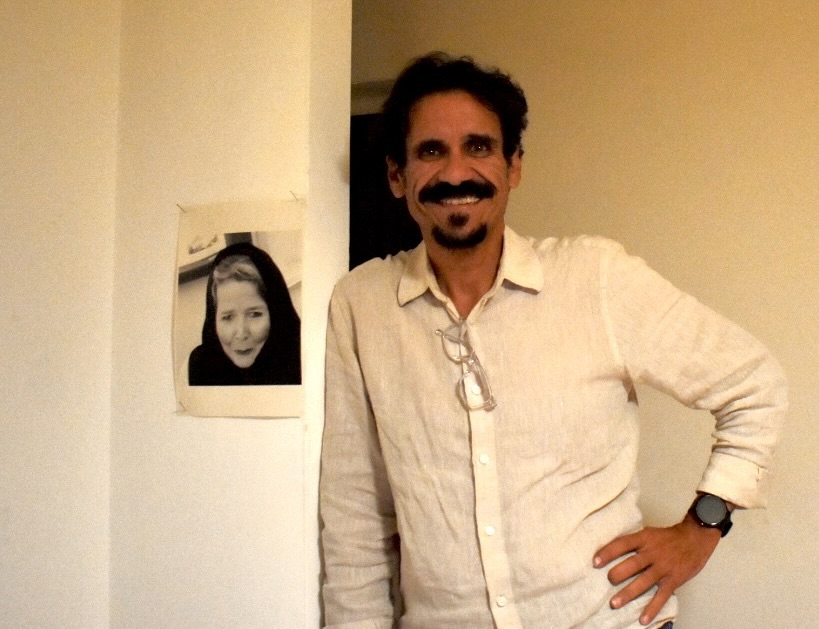
The photo above is Jono in his Tangier home, and then here below he’s photograped top right in the New York Times article that had taken me to Tangier in the first place ( little imagining I’d meet any of the people in the article), and at the bottom, with Anthony Bourdain who – Jono later told me – also met him by chance on the street… :
Jono and I went to a service at the St Andrews Church in Tangier one day.
After church we drank cold water in plastic cups and fell in with the vicar and a scraggy cheerful and colourful group of Mauritanians. The vicar was a friendly bon viveur of the colonial type and a terrible snob, who was quick to tell people that he was – at that time – the chaplain to the Queen. He was also quick to make a few comments about our Muslim brethren:
“Watch your purse, and yourself. These people will latch onto you and you’ll never get rid of them..they come triapising all the way up here from Mauritania and try to get on boats across to Spain, only to be turned away by the Moroccan police and sent packing down south again. Then they come back up a few days later. Some of them come to church because they know there’s a bit of money here and some kind of social conscience.”
Jono had the finances, health and leisure to live exactly as he chose, but he had something much rarer too: the imagination to actually do it.
And he did his Tangier daily life well, which is what I loved most about him.
Soon after our first meeting, he and I got into a tacit loose-fitting kind of arrangement which meant sometimes meeting at the Tingis Café, sometimes at the Cinéma Rif, sometimes at the French bookshop, or even just on the streets, and none of it ever by arrangement.
” I’m terribly spoilt, you know. Pa left me quite a lot of lolly a long time ago now, so I just stopped working. Used to be a journalist, bit of a hack, to tell you the truth. Lived in Cairo for a while, fascinating place, have you been? I first came to dear old Tangier 30 years ago, was sent out by my paper in London on a story about artists here. Never left, really.”
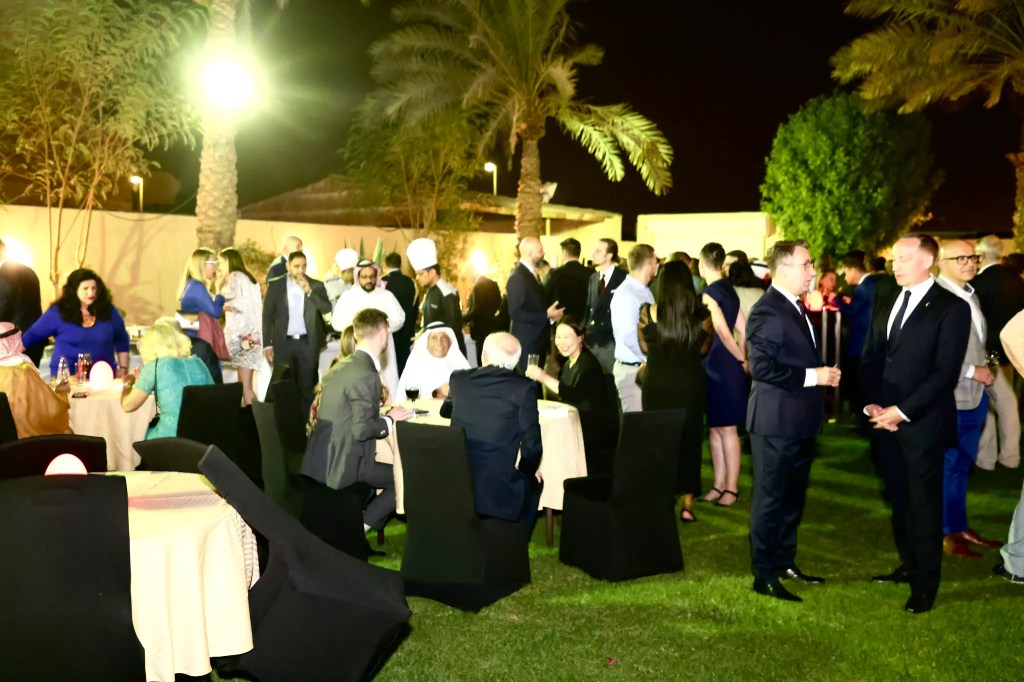
Living and working with 250 English-speaking women colleagues on a gated campus in Saudi Arabia was quite an experience, and to this day makes me question many aspects of ‘the sisterhood’, and a lot else.
The confining conditions – think Mallory Towers meets Alcatraz – sometimes brought out the worst in us all, and the financial stakes (described by one wag as ‘the money addiction’) were high, which added to the stress.
* * *
Nevertheless, the experience was highly entertaining a lot of the time, many colleagues were talented, clever and funny, and some inconsequential story or another was always on the go. Once or twice though, there was an exceptional event involving an exceptional character.
One such was called Morag, and as soon as she arrived, she advertised an already-opened packet of porridge oats on our staff intranet for 50 cents, which was derided as weird and miserly, and much criticised at the time.
Obviously Morag was flat broke and gossip quickly fired up and darted through the university about her supporting some boyfriend or another on a Greek island, plus his mother ( her name was even mentioned in some versions, Sophia ).
* * * *
Morag began her contract just when a well-known Saudi bank opened a branch on campus, and they were giving out credit cards to anyone who asked. We all had good salaries and were working for the same university, so it was easy and quick to get a card, with generous credit on it too.
She might have been penniless, but Morag was neither daft nor slow. Within weeks, she managed to get two Visa cards, pocket the substantial credit (rumoured to be around $20,000) and leave the country on the next flight out.
Of course there was a lot of finger-wagging afterwards, but once that was over, Morag’s reputation acquired the secret admiration and sparkle that the crafty fly-by-night often tends to enjoy.
She was last sighted two years later in expensive clothes on Berlin’s Kurfürstendamm, sans boyfriend (and sans Sophia).
It didn’t take long for my experiences in Saudi Arabia to jolt me into realising that the Eurocentric world vision is just as limited as any other, and that I too had been influenced by a whole lot of nonsense about ‘the Magic Kingdom’.
For a start, most of the Saudis I met in my three years there – in three very different regions – were welcoming, warm, and fun.
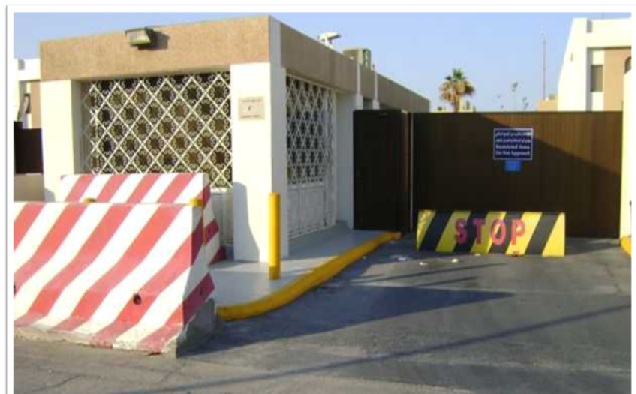
What was more challenging about Saudi Arabia, however, was living with 250 other English language instructors in a gated university campus just outside the capital, Riyadh.
You had to be a certain feisty type of Western woman to choose to work in what at that time was a hermetic country, to arrive there alone, and comply with the prison-like restrictions of the contract. And of course it’s the feisty among us that find it most difficult to obey rules.
For example, you couldn’t get back out of the country unless three of your bosses authorised it with their signatures. You could be dismissed within minutes though, and deported on the next flight out. Your visa was in the hands of your employers, you had to share an apartment with a colleague you’d never met, you couldn’t be seen with a man in a public place, and on top of all that, it was forbidden to discuss various key topics in the classroom ( outside it too, so it was not dissimilar to the United States at the moment ). Also, women weren’t allowed to drive then, and there was no Uber, and no public transport.
The reason of course most of us went to Saudi Arabia – and happily signed our contracts – was the time-honoured immigrant worker’s pursuit of money, but the country attracted people for other motives too, which became clearer as the months went by.
‘Look, you don’t actually have to speak, you know. They’re there to talk about themselves and won’t listen to a word you say anyway.’
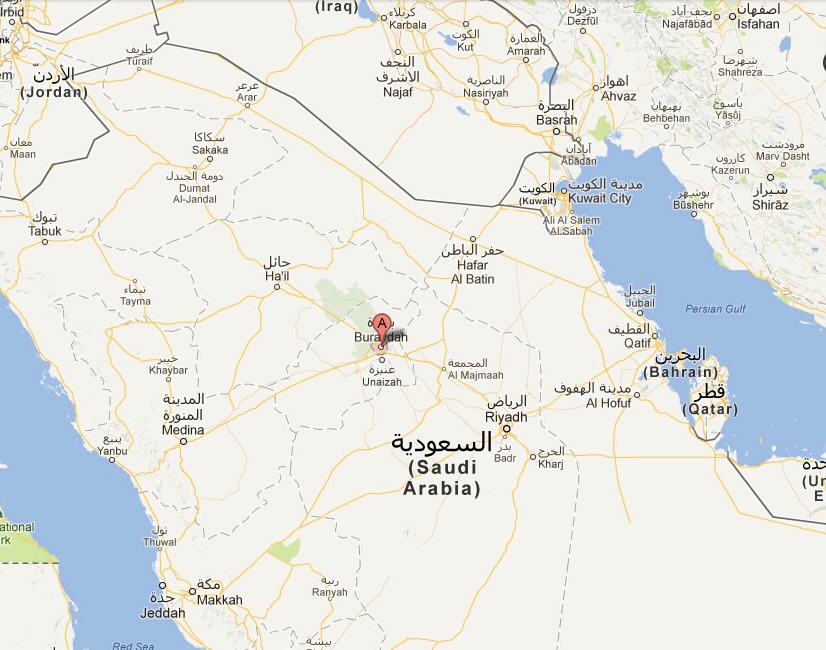
Sherry Lee and I were having coffeee at an uninteresting café in Saudi Arabia, in the town of Buraidah, in the isolated region of Qassim, known (to few) for its camel market and dates.
The end of the month was arriving fast and Sherry Lee was short of cash.
‘I’ve been doing it since I got here. But only at the end of the month, though, when I want a bit of fine dining and I’m low on the bucks’.
Sherry Lee was quick-witted and entertaining, not too great in the looks department, and enjoyed a certain cachet – or renown at least – in expat teaching circles throughout Saudi Arabia because she’d once been driven into such a tantrum by the students that she’d grabbed a girl’s phone from her desk and smashed it to pieces on the classroom floor.
This had caused great hilarity and feigned outrage from the students, of course, and Sherry Lee was sacked on the spot and ushered onto the next plane out of the country….only to briefly dust herself down back in the States, find another job in another town in Saudi and start afresh a few months later.
So we were having coffee in that ‘other town’, Buraidah, and Sherry Lee was trying to persuade me to join her in her latest scheme, which was going onto some kind of dating site ( at that time forbidden in the kingdom), hounding out an unwitting Saudi guy who was lonely and keen to speak English, and getting a free meal in a fancy restaurant as the reward.
‘Aw c’mon. Women- and men too – do this all the time all over the world ! It’ll be much more fun if there’s four of us. A double date. Awesome ! You don’t have to put on the slap, just try to be kinda nice, and interested in their jobs or whatever it is they’re talking about.’
I quite liked Sherry Lee, but not this side of her, which to me seemed merciless and cynical.
‘Think about it, hon – it’s a win-win. The guy gets someone to listen to him, and to speak English, and you get the fine dining. They’ve got fresh salmon at that new place downtown! Yay !’
Needless to say I did not join her on her little monthly dinner dates, maybe not due to any moral high ground posturing, but more because I knew I couldn’t sit through an entire evening listening to anyone talking about their job, no matter how fine the dining, or how attractive the companion.
I must admit though, that I found Sherry Lee’s crafty inventiveness quite fascinating, even though it was cruel.
…. so I’m 67 , which feels like the old 90 at times, and I’m told by one or two younger friends that I should be feeling guilty because we Baby Boomers are the last generation to be getting a state pension, but that’s not my concern here. My focus now is on how to get and nurture a postitive approach to this retirement lark. Some of it is great, but a lot is not.
It’s not as if I’d been doing some ghastly job for 40 years that I was dying to give up so I could start gardening or golfing. In fact, the well-meaning but rather insulting suggestions – often made by the young, or those who actually can’t wait to stop working – of taking up a hobby, joining a club or having a walk in the mountains are all nails in the coffin to me, so I won’t be doing them. At least not for a while, because I’ve started attending classes in the Faculty of Arts at my local university here in Italy.
My classmates are about 45 years younger than me, and I’m more or less twice the age of the professors but it’s testament to everyone’s good natures that I don’t feel too awkward or unwanted. A few kind fellow students have offered to give me the reading lists, one or two say hello to me in the corridors, and the professors are courteous and welcoming. Some are gifted at teaching and passionate about their subjects, and the classes are dinky small.
This week, one lecturer even mentioned almost to the word, phrases delivered to me as a university undegraduate 50 years ago (at Aberdeen University, Scotland ) : ‘all art is selection and rejection, Apollo over Dionysus, order over disorder.’ Nothing new under the sun in this case, but I’m enjoying a different angle on familiar concepts, and discovering fresh ones too.
It’s not the architecture, the incense or the stained glass, or – if you’re lucky – a sense of the mystery of life: and it’s not the clergy either.
It’s more that there’s nothing like a good church in a foreign country for getting a sense of where you are, and finding out who else is there too.
If you’re in a big city abroad, going to a chuch service ( or better still, to a social occasion after one) is an excellent way of mixing with people, and very quick and handy if you’re travelling around and feel a bit lonely, even if you don’t have any religious affiliations or beliefs. You can contribute your own participation and presence to any congregation or communtiy, and you’ll get a nice welcome in return.
Going to church abroad is also less stressful than fabricating your best self online, scrolling through dating apps, or sitting awkwardly at Meetups or Internations social events, hoping someone will speak to you or worse, that you don’t have to sit beside someone dull. And if you’re in a country where Christianity is a minority religion (in some places there are secret churches with whispered addresses ), you’ll come across a certain type of person, maybe not the type you normally meet.
The Church of Scotland in Rome, for example, has a lovely congregation and a great terrace with views overlooking the entire city. You’ll get a good international chat up there after the Sunday service. Same if you go to St Joseph’s Cathedral in Hanoi, where it’s easy to fall in with all kinds of people after mass. Then there’s the beautiful St Andrews Church in Tangier ( painted by Matisse ), where you’ll get a warm chat with young Mauritanians and Liberians – along with the local literati – in the garden in its bright sunlight after the service.
( Dinner in the trattoria ‘Da Rino’ – with the light at the doorway on the left – in Via San Marciano, L’Aquila, the regional capital of Abruzzo, 110 km east of Rome )
‘Dolce Signora, the delicious, fresh chicory you are about to eat comes from the Gran Sasso – it grows up there, you know, on the highest mountain in the Apennines,’ Rino said, with charming inaccuracy, as he bowed not quite obsequiously at a table of Roman tourists.
The Roman tourists shrieked at how lucky they were to have such special Abruzzo food, and with evident pleasure, mirth and not a little noise, chatted on for quite some time about the merits of life in the provinces.
I was having dinner ( as I often did, and for about two hours every time) with my belovèd friend, Mino, who poured me out another glass of the local red wine, so dark that it stains your tongue if you drink it enough. Rino always left a litre of this vino nero on the table for us and we paid for what we drank, usually the lot .
It was cold and snowy outside, Sunday evening, and the trattoria was busy. The small high windows were beginning to steam up and the two little vaulted rooms glowed with cameradie and pleasure.
There was glass across the top part of the arched wooden doors, with little white cotton curtains held up by narrow brass rods, and every time someone came in, the rods rattled slightly against the thin panes, and heads went up to shout out some welcoming comment to a known face, or a buona sera to a stranger.
‘ E voilà , bella Jo!’
Rino put a triumphant plate of strangolapreti ( ‘priest stranglers’ ) pasta on the white tablecloth in front of me, moving my cigarette packet and other personal odds and ends out of the way to make room for it.
‘ Eat it up now or it’ll get cold and none of your smoking and chattering, ah bella Jo… bella Jo.’
He used the word ‘bella’ for most of his women customers, but even so, it was always endearing (and still is) .
At the table opposite us was a group of young men in overalls, heads bent over their plates, stubby fingers soaking up the remains of food with the customary scarpetta. From time to time the Romans bawled across, engaged them in some inconsequential but friendly chatter and chortled on through their hearty fare.
Mino and I had got onto our main course, castrato (which means what you think, of the sheep family), roast potatoes, spinaci in padella,peperoncino and garlic.
Rino was now amusing other diners by dousing their portions of fresh pineapple rings in the Abruzzese centerbe liqueur. Then with the flourish of a magician, he set the rings alight. Gasps of awe rippled through the trattoria as the turquoise flames flared for a second, then flickered just as quickly to nothing.
Mino and I finished off our vino nero , stood up in the cramped space, and asked for the bill. Rino did all the arithmetic in his head, or sometimes with a few lightning squiggles in ballpoint on a little notepad. He always rounded the price down for us.
Before I left, I went into the kitchen to see his wife, Loredana, the trattoria cook, dishwasher, and peacekeeper. She immediately abandoned her steaming pots and pans, hot water and chopping board to greet me. Her grin showed the little gap between her front teeth, and she wiped her strong hands before shaking mine, on a stained white apron. She asked how my family was and told me her own news, chucked me on the cheek like a child, then kissed me goodbye.
I left to an arrivederci from the entire trattoria and joined Mino back out on the wintry streets to whatever it was that awaited us next.